Close Menu
  • The Green Spotlight
  • Success Stories
  • Climate Tech
    • Energy
  • Mixed
    • Climate Comics
    • News and Views
  • Products and Services
    • The Green Spotlight
    • The Green Spotlight – INTERVIEW FORM
    • Green Case Studies
    • Green Leader Profiles
    • Green Mini Case Studies
    • Tech Writing, White Papers, Editing, and More
    • Service Pricing
  • About
    • About Us
    • The Story of Green Success Stories
    • Call To Action
    • How You Can Help
    • Contact Form
    • Schedule a Zoom Meeting
    • Write a Testimonial About Us
Facebook Instagram X (Twitter) LinkedIn
Green Success StoriesGreen Success Stories
  • The Green Spotlight
  • Success Stories
  • Climate Tech
    • Energy
  • Mixed
    • Climate Comics
    • News and Views
  • Products and Services
    • The Green Spotlight
    • The Green Spotlight – INTERVIEW FORM
    • Green Case Studies
    • Green Leader Profiles
    • Green Mini Case Studies
    • Tech Writing, White Papers, Editing, and More
    • Service Pricing
  • About
    • About Us
    • The Story of Green Success Stories
    • Call To Action
    • How You Can Help
    • Contact Form
    • Schedule a Zoom Meeting
    • Write a Testimonial About Us
Green Success StoriesGreen Success Stories
Success Stories

Green Success Story: Lungdon, England

Share
Facebook Twitter LinkedIn Pinterest Email

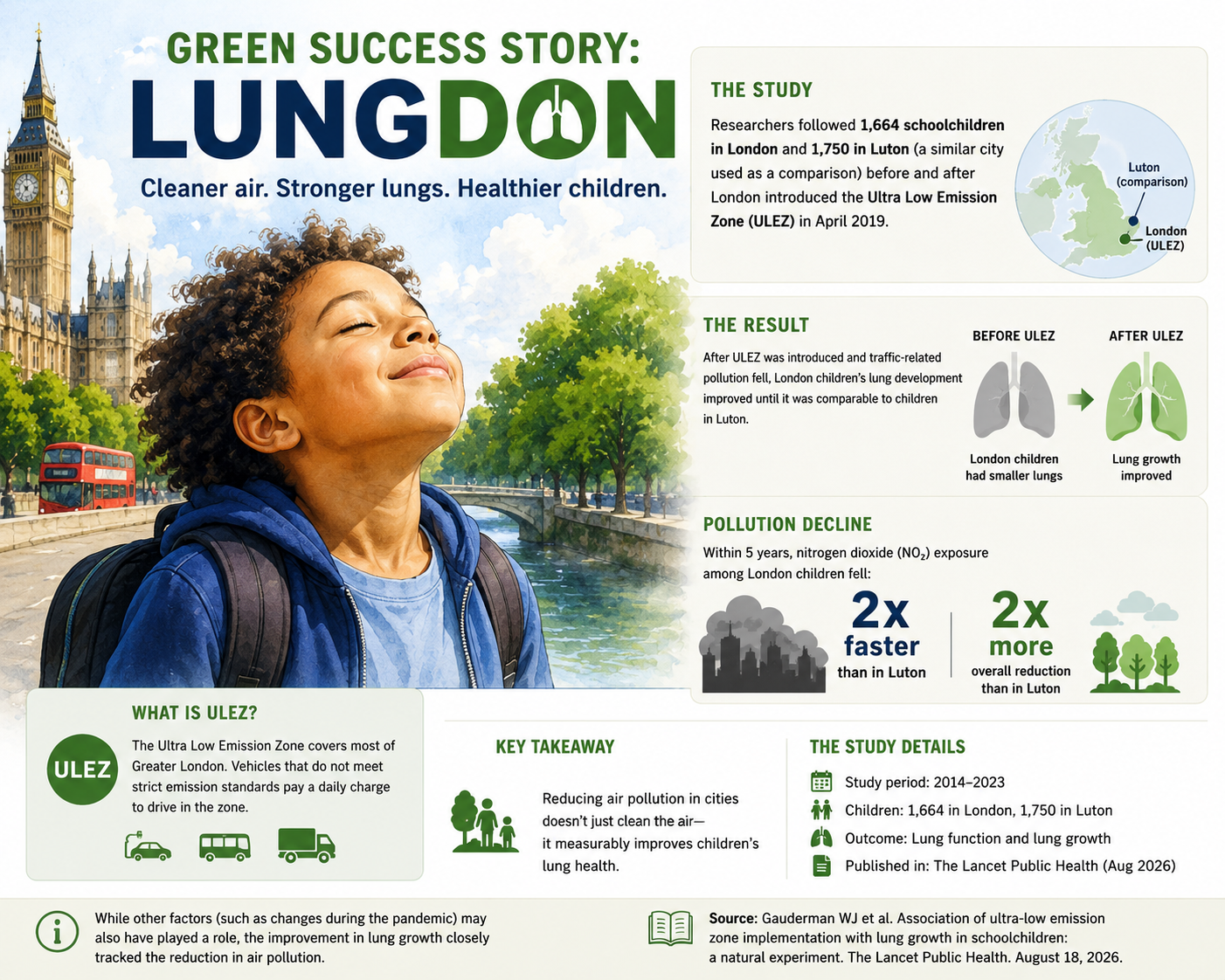
Reducing air pollution in cities doesn’t just clean the air, it measurably improves children’s lung health.

Well, Green Success Stories would love to see more of those kind of success stories.

Especially considering some of these suffocating statistics:

  • 99% of the world’s population breathes air that exceeds WHO air-quality guidelines.

    Source: World Health Organization (WHO). This figure comes from WHO’s global assessment of exposure to fine particulate matter (PM?.?). WHO states that in 2019, 99% of the global population lived in places where its recommended air-quality levels were not met. WHO develops these estimates using air-quality monitoring along with other exposure data; its guideline for annual average PM?.? is designed around concentrations associated with health risk.

    WHO — Ambient air pollution and health

  • About 7 million premature deaths every year are associated with outdoor and household air pollution, according to WHO.

    Source: World Health Organization. WHO’s current public-facing air-pollution material says the combined effects of ambient (outdoor) and household air pollution are associated with approximately 7 million premature deaths annually. The principal causes include heart disease, stroke, COPD, lung cancer and acute respiratory infections. WHO adjusts its combined estimate to prevent double-counting people exposed to both household and outdoor pollution.

    Important update: A WHO technical brief released in June 2026 gives the more precise current estimate as about 6.6 million deaths globally per year. So for a blog post, I’d phrase this as “about 7 million annually” rather than implying that 7.0 million is an exact count.

    WHO — Health effects of air pollution: 2026 technical brief

  • A separate major global analysis estimates 7.9 million pollution-attributable deaths in 2023; the difference reflects methodology.

    Source: State of Global Air 2025, produced by the Health Effects Institute in partnership with the Institute for Health Metrics and Evaluation (IHME) and based on the Global Burden of Disease methodology.

    This is a different analytical system from WHO’s estimate. It uses the Global Burden of Disease framework to estimate how many deaths would not have occurred at that time if populations had experienced a specified theoretical minimum level of air-pollution exposure. That is why its figure should not be treated as a direct update to or contradiction of WHO’s approximately 7-million estimate. The organizations use different methodologies, exposure estimates and reference assumptions.

  • 676,000 children under age 5 died from causes linked to air pollution in 2023—about 27% of all deaths in that age group worldwide.

    Source: State of Global Air 2025. This is also derived from the Global Burden of Disease analysis. The report estimates that 676,000 deaths among children younger than five in 2023 were attributable to air-pollution exposure, representing 27% of all deaths among children under five globally.

    An especially important detail: the analysis attributes 75% of those pollution-related childhood deaths to household air pollution, predominantly exposure created by burning solid fuels for cooking. Children are particularly vulnerable because their lungs, brains, immune systems and other organs are still developing.

    State of Global Air — Impacts on Children Under Five

Yup, lots of work to do.

But we have had some success stories we can point to.

Like the London lungs story. Or

Clean-air policies have produced major, measurable gains, even though air pollution remains a huge global health problem. In the United States, emissions of major common air pollutants have fallen 79% since 1970, following implementation of the Clean Air Act and advances in pollution-control technology; annual average fine-particle (PM?.?) concentrations fell 46% between 2000 and 2024. EPA estimates that Clean Air Act improvements prevented more than 230,000 premature deaths in 2020 alone. Globally, progress is much more uneven: exposure to PM?.? has declined in many places, but population growth and aging—especially in highly polluted countries—mean the worldwide health burden remains enormous. WHO member states have now adopted a goal of cutting the health impacts of air pollution in half by 2040.

Sources: EPA — Our Nation’s Air 2025 · EPA — Clean Air Act and the Economy · State of Global Air 2025 · WHO — Global air-pollution target

It’s encouraging. But there’s a long way to go.

And here’s a little ditty

Here’s a little ditty from way back when in 1967 that still rings true. Just two things of which you must beware: Don’t drink the water and don’t breathe the air.




Share this:

  • Click to share on Facebook (Opens in new window) Facebook
  • Click to share on X (Opens in new window) X
  • Click to share on LinkedIn (Opens in new window) LinkedIn
  • Click to share on Reddit (Opens in new window) Reddit
  • Click to email a link to a friend (Opens in new window) Email

Related

Share. Facebook Twitter Pinterest LinkedIn Tumblr Email

Related Posts

Success Stories

Green Success Story: New World Mine Agreement

August 12, 2026By Green Success Stories
Read More
Success Stories

Green Success Stories: Gifford Pinchot

August 11, 2026By Green Success Stories
Read More
Success Stories

Green Success Story: Florida Underwater Coastal Corridor

August 10, 2026By Green Success Stories
Read More

Leave a ReplyCancel reply

The Green Spotlight


Designing and Building Regenerative Communities That Enable Sustainable Living Without Sacrifice

Driving Sustainability with Innovative Green Road Solutions

Leading the Way in Youth Environmental Education

Fostering Deeply Connected Climate Solutions via Water and Infrastructure Policy

Help Support Us!

Like what we’re doing? Please pitch in, and help us highlight leaders in the fight against global warming. THANK YOU!


Facebook Instagram X (Twitter) LinkedIn
© 2026 ThemeSphere. Designed by ThemeSphere.

Type above and press Enter to search. Press Esc to cancel.


Loading Comments...